February 26, 2006

Highlights of last week's trip to New York City, in order of importance to Nathaniel and Jessica:
  1. Sighting a live rat in the subway tunnels. "A real rat!" cried Nathaniel, pointing excitedly from the platform among hundreds of jaded Manhattanites intently tuned to their iPods.

  2. Grafitti: "Sometimes they have pictures, and sometimes they're just words."

  3. A boxy, yellow ferry that the children sighted as we tried to direct their gaze to the Statue of Liberty: "It's the Magic School Bus!"

  4. Trash deposited onto the sidewalk in front of businesses.

  5. Burglar bars on windows.

  6. Construction of some sort on every corner.

Their list might not exactly match ours (a broadway play, the shrine of St. Elizabeth Seton, the site of the World Trade Center, Hassidic and Polish neighborhoods in Brooklyn . . . ) but learning takes many forms. At least that's what we're telling ourselves.

February 07, 2006

Updates to Kids' Reading List

The Cates have published the latest Carnival of Homeschooling so we can all catch up with reading homeschooling-related blogs.

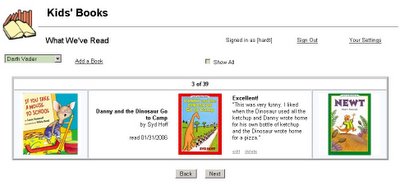
Regarding our own reading, I updated the website that we use to track the kids' reading. A simple rating system lets readers rate their books from Bad to Excellent!

I also "Ajaxified" the interface so it retrieves book information on the fly instead of rebuilding the whole page. (That previous sentence may mean something to technical types.)

Anyone is welcome to track his or her reading on this site.

February 06, 2006

Streetwise and Sheltered

Our children, five and seven, are streetwise and sheltered, sophisticated and naive, in very strange ways. I wonder if these paradoxes are typical of homeschooled children.

  • They know about the war in Iraq and the controversy surrounding it, but they don't know Sponge Bob from South Park.

  • They are aware that they have biological parents and foster parents overseas, but they aren't aware that Mom and Dad have ever disagreed about matters of child-rearing.

  • They have some understanding of the major religions' creeds, but they don't recognize curse words.

  • We read them stories like The Island of the Blue Dolphins, in which wild dogs kill the heroine's brother, but we won't let them watch Jurassic Park because of the violence.

  • They are comfortable discussing President Jackson's displacement of the Cherokees on the Trail of Tears but they don't know the lyrics to any Billboard songs.
I guess Mom and Dad are sheltered too. Last week we watched Citizen Kane and Song of the Thin Man, but we haven't seen any of the films that have been nominated for this year's academy awards.

February 02, 2006

Pirate Maps and Compass Directions

One of our recent “science” lessons involved mapping and compass directions. Camille spent roughly a week on the topic and did a wonderful job working in the children's recent learning about early American history: they could understand that the Europeans came west across the Atlantic, and they now have a sense of how western expansion proceeded across the United States.

I got to cap the week with a little lesson of my own. I pulled an image of a pirate's treasure map off the Internet. It showed a desert isle with palm trees and boulders and had a weathered look about it.

Then I overlaid a grid pattern onto the map using the transparency layers built into Paint.Net (my free, image-editing tool of choice). I printed the map, drew a starting point on it, and worked out a series of steps to navigate from here to there on the paper. I put the steps into a “pirate” letter:

Dear Pirate,
A. Move two steps to the north.
B. Walk four steps to the west.
C. Swim three squares to the north.
etc.
Hugs and Kisses,
Long John Silver

Another copy of the map served as the answer key. On this copy, I drew a “treasure” on the correct end-spot. The children worked through the exercise, and when they came to the end, they punched holes in their maps. By holding their maps over my key, we could see whether or not they had successfully “found” the treasure by looking through the whole.

A few weeks later, Camille was teaching the children measurement, and I resurrected the pirate maps. This time I gave the instructions in inches: “Move two inches to the north,” etc. Again, the game was a hit.

I'm toying with the idea of creating an online version of the exercise, but I'm not sure kids would enjoy it as much. Our children really savored physically marking up their maps and punching those holes once they had pinpointed the treasures.

January 31, 2006

Reading of All Flavors

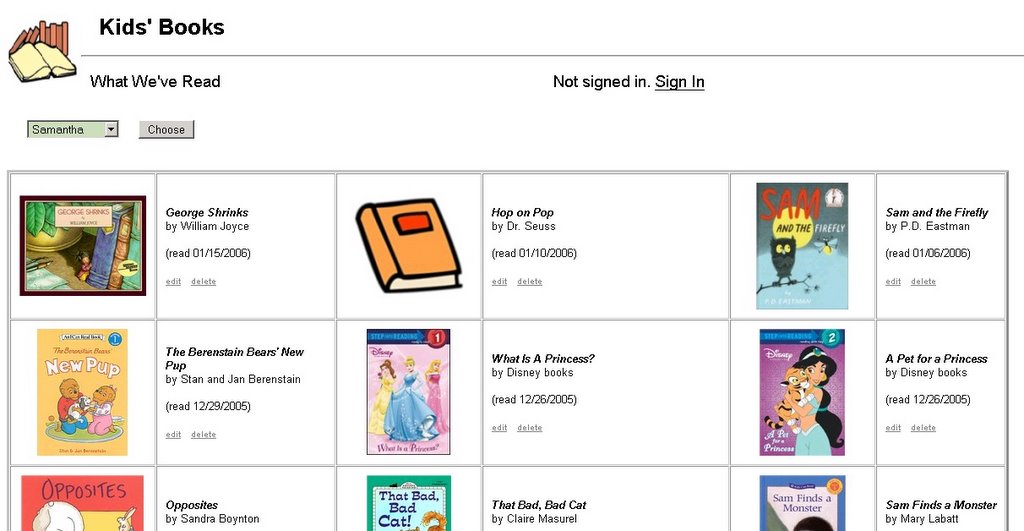
The children's booklist is working a little more smoothly than it was a week ago. Check it out to see what some of our children have been reading lately.

My own reading (Tolstoy's Resurrection) will get pushed aside today while I browse the Fifth Carnival of Homeschooling.

January 30, 2006

Why My Son Reads

Recently I caught Nathaniel reading to his little sister, Jessica. Getting Nathaniel to read is always a challenge, so you can imagine the warm thrill that went through me when I overheard them.

That morning he had read The Berenstain Bears and the Spooky Old Tree to me. He had enjoyed the story, but once we closed the book, I thought it was over.

That afternoon the kids were being suspiciously quiet, so I went to check on them, half expecting to uncover activity that would necessitate a trip to Home Depot. I heard Nathaniel's voice through the slightly-open door, and something in his tone made me linger a moment.

He was reading! To his sister! Without parental compulsion!

I flung open the door with pride. "So, you're reading to your sister, Nathaniel!"

Both children looked at me impatiently, even aloof.

"Dad, we're trying to read. Leave us alone."

These glimpses of looming adolescence scare me in my young children. I left them.

A week or two went by, and I realized that Nathaniel wasn't reading to Jessica anymore. I asked why not.

"I don't read to Jessica," he said flatly.

"But you had fun reading her The Spooky Old Tree, didn't you?"

"Oh, that," he said as if I should have been able to figure this out on my own. "That was to scare her."

January 25, 2006

Homeschool Paperwork Reduction Act

HB 406

Last week the state legislature approved House Bill 406, the "Homeschool Paperwork Reduction Act." The result is that New Hampshire homeschoolers no longer need to file curriculum plans with the school districts at the start of each school year. Now we need only administer annual achievement tests to confirm our children's progress.

Common sense favors the passage of this bill:


  • The requirement to submit a curriculum was redundant, since annual evaluations ensure that homeschooled children are receiving an adequate education.

  • There was no standard form for describing a curriculum. How could the government judge whether one parent's three-sentence write-up described a better or worse education than another parent's table of contents from a purchased curriculum?

  • The requirement created extra paperwork for homeschoolers and the school districts alike.

  • It just doesn't make sense for public school districts to review homeschool curricula. How could a public school district, committed to the separation of church and state and the mainstreaming of special-needs children, go about approving, for example, the distinctly Christian curriculum of a homeschooler who withdrew her children from public school because she didn't believe the school was addressing their special needs?

  • In practice, curricula were collected, but never reviewed. (I don't know this for sure—it's what I understand from anecdotal evidence.)


On the other hand, the requirement to submit a curriculum, while bureaucratic and unnecessary, wasn't really harmful:


  • Submitting a curriculum wasn't onerous. We struggled with how to begin because there were so few samples online, but Camille assembled our curriculum in a few hours.

  • I'm not convinced it hurts to lay out a year-long plan for your child's education, even if you end up changing it.

  • Reviewing New Hampshire's public educational requirements in order to submit a curriculum gave us confidence that we weren't overlooking anything in our own plans.

  • Having our curriculum "approved" (even though it was probably never reviewed), was psychologically reassuring. It felt less like we were sneaking around the system. It validated our choice to homeschool.


Can Red Tape Protect Homeschoolers?

I wonder if the curriculum requirement actually protected homeschoolers. We're a minority, but by keeping one toe in the public educational system, we show our willingness to participate in majority culture. Submitting a curriculum helps to keep the uneasy alliance between public educators and homeschoolers from becoming a rift.

Here's the worst thing that I can imagine happening to the homeschool movement:

A parent who is abusive or negligent or otherwise criminal chooses to homeschool his children—but not in order to educate them. He does it in order to fly under the radar. He doesn't want his kids in school because teachers might notice the scars or hear that Daddy makes bombs in the basement. (We store books in our basement, but I do have a vivid imagination!)

Might this insignificant, cursory, bureaucratic requirement pose a barrier to such a person?

I don't know.

But if such a horror story ever does make the New Hampshire nightly news, I bet there will be somebody pointing out that the children of homeschoolers are totally outside of the system, that homeschoolers don't even have to share a curriculum with the state. Then where will we be?

January 23, 2006

Kids' Books -- Online Reading List

A while back I was thinking that I wanted the kids to have a place online where they could track what books they had read.

I wanted:

  • A site anybody could visit to see what the kids have been reading lately.

  • A forum where the kids could post very short “reviews” to recommend books to friends.

  • Anonymity for children online.

I couldn't find any existing solution that seemed quite right, so I finally set up my own website.


If you want to see what Nathaniel and Jessica have been reading lately, check out www.Books.CriticalMap.com. Click on "Darth Vader" (Nathaniel) or "Samantha" (Jessica) in the list, and then click the Choose button.

If you like this system, you are welcome to try adding your own child's reading. The instructions are below.

(Please keep in mind that this site is a hobby for me, not a job . . . and that you get wait you pay for!)

How to Add Your Child's Reading to the List in Just 8 (formerly 14!) Steps

  1. Go to www.Books.CriticalMap.com.

  2. Click on Sign In.

  3. Click on the words Click to Register.

  4. Fill out a name, a password, and an email address. (I will absolutely never share the email with anyone under any circumstances. I'll use it only to confirm passwords or notify you of any changes.)

  5. Click Your Settings.

  6. Click Add a Child to Your List.

  7. Enter the name you want to appear for the child and click the button. (I'm not comfortable putting our kids' names on the Internet, so I let the kids pick their own "Code Names.")

  8. You should see a link next to the Choose button called Add a Book. Click it, and you can start building your child's reading list.


Your child's books won't show up with pictures at first. As time permits, Camille and I will fill in the graphics.

Let me know what you think!

January 17, 2006

Homeschooling Blogs and E.B. White

Lately I've been reading One Man's Meat by E.B. White. I've decided this book is a blog from a time before blogs.

I admire E.B. White. He's the sophisticated writer from The New Yorker who led an alternate life on a small farm on the coast of Maine. He's the terse wordsmith who gave us the latter half of Strunk and White's The Elements of Style. He's the children's author who invented Charlotte's Web and The Trumpet of the Swan: books that should be staples of any child's reading.

One Man's Meat is a collection of essays written after he moved to his farm in 1938. The essays aren't quite articles, and they aren't quite diary entries either.

He tells of his first efforts to keep hens and how he dealt with a surplus of eggs. He compares his dog to one in an advertisement for Camel cigarettes. He sings the praises of his son's one-room schoolhouse—the boy had previously attended an elite private school in New York. He tells of shingling his barn while Britain and France gave Czechoslovakia to Hitler via the Munich Accord.

For more contemporary blogs related to homeschooling, see the Cate family's Carnival of Homeschooling, Week 3.

January 15, 2006

Skating and Raising the Bar

Last week we took the kids skating for the first time at a pond in beautiful, nearby White Park. (Actually the pond was a lot more beautiful before some zealot from the DOT decided that the playing fields needed to be snowplowed in order to provide parking for the skaters, but that's another story.)

Nathaniel was a natural on ice. Jessica cried the first time she felt unsteady on her legs, immediately fell down and threw a tantrum, and spent most of the outing on her belly. Seeing her took me back to my own childhood when my brother and I went skating. Neither of us was a natural, like Nathaniel. I just sulked and refused to skate. My brother followed Jessica's example, crying and sitting on the ice.

My parents were sympathetic and protective, and I never did learn to skate--not well, anyway. I wonder if they did us a disservice?

My wondering points to a fundamental question of teaching: to what extent should we pamper our children and ease their learning, and to what extent should we push our children and urge them beyond their capabilities?

Public schools fail to raise the bar for most kids just because they teach to a point that sits slightly left of average on the bell curve. (I'm sure some would dispute this claim, but I'm convinced of it from my own teaching and schooling. Anecdotal evidence from other public school teachers confirms my opinion.) A teacher with 27 students who are struggling to subtract isn't able to spend much time encouraging the 3 who are almost able to divide.

Homeschool teachers can more easily raise the bar. We can more easily lower it, too. If Johnny is an “actual-spontaneous” learner (an energetic, hands-on type who dislikes bookwork), Mom faces a real temptation. After all, she could customize Johnny's education so much toward his strengths and away from his weaknesses that Johnny never will learn self-discipline, or read for pleasure, or be able to wait for something worthwhile. On the other hand, in an effort to overcome any weaknesses in Johnny's personality, Dad might push too hard, until Johnny despairs and believes himself a failure.

I conclude that this question of raising the bar is a balancing act. We have to watch our kids, weigh their triumphs and failures, and decide when and how hard to push.

. . .

Or so I thought.

The end of this story belies my reasoning. Camille took the kids skating again the following day. Nathaniel, aggressive and cocky on his second day out, fell hard and broke his clavicle: he's out for the season. Just before skating was aborted for a trip to the hospital, however, Jessica, under pressure, on her own time, perhaps feeling a competitive urge to match her brother's performance, started skating. She has been out for a third time, and she's really taking off.

So Nathaniel, whom we didn't push at all, tried so hard that he literally broke himself. And Jessica, whom I worried that I was pushing too hard, is flourishing. If this means something, I don't know what it is.