April 19, 2006

Hair Conditioner vs. Lucy and Ricky

At five, Jessica is finally developing a sense of modesty. I think the days of my helping her out when she showers are at an end.

This is good news. As an infant, Jessica went into hysterics whenever she felt water on her face. Just as she outgrew that phobia, her hair became long enough to tangle.

Tangles in Jessica's hair were such a large part of our family life that Camille actually began naming them—the tangles—after characters from I Love Lucy. To this day, if Jessica feels a pull over her left parietal lobe, she'll say menacingly, "Watch it, Ethel!"

I've always been short-haired, so I had no experience with snarls. After years of struggling quietly, I finally appealed to Camille for guidance and learned how to remove tangles from Jessica's hair. Since I'll probably forget soon, I record this for posterity.

  1. Let the child wet her own hair. She will take too long and concoct Gordian knots on her head.

  2. Help the child shampoo.

  3. Let the child rinse. Generally I pull out a book and let her play a bit at this point.

  4. Apply conditioner. I used to think of conditioner as some alchemical potion that gives hair "body" and "luster." Camille taught me it's a simple lubricant, like WD-40 or vegetable oil. Conditioned tangles slide apart easily. Camille suggested that I needed to condition only the hair hanging down Jessica's back, but I take no chances and coat her whole head.

  5. The child can bathe while the conditioner soaks in.

  6. Starting at the bottom, brush her hair downward. This means that for the first few strokes of the brush, I fix only the tangles at the bottom of the hair. Once they are cleared out, move up an inch, and repeat. If the child's hair is long enough, you can also grip the middle of it tightly in one hand so that even if tangles exist at the end, the child will not feel the pulling.

  7. Be careful not to brush too hard against the child's scalp. (I wrongly assumed for months that Jessica was complaining about hair pulls from tangles, when actually I was scraping her scalp with the bristles.)

  8. Brush her hair under the shower stream until the conditioner is mostly rinsed out.

In short, my answer is chemical warfare: in the battle against tangles, conditioner is my weapon.

April 11, 2006

Funny Moment at Church

Another homeschooling father recently described his daughter's reminding a priest of the role of Mary in salvation history.

His story brought to mind something Jessica said once.

We encourage our kids to pay attention to the Gospel readings, and (most of the time) Camille even prepares them in advance.

Once we were attending Mass in the chancel of a Benedictine monastery--very close quarters. The reading was Matthew's Infancy Narrative.

Jessica sat quietly until Herod's line, "Go and search diligently for the child, and when you have found him bring me word, that I too may come and worship him." At that point she couldn't contain her excitement and hissed audibly, "He's lying. He wants to kill Jesus!"

The reader only paused a moment to compose himself, but there was laughter in everyone's eyes.

April 10, 2006

Make Your Own Educational Map

[This post is out-of-date. The growth in online maps in the past couple of years has been staggering. If you are interested in customizing maps for educational use, I recommend the My Maps feature in Google Maps. And make your maps public, so the rest of us can use them, too!]

I've recently created a website that I want to share with other homeschoolers. It's here (www.kids.criticalmap.com).

When I first saw Google's online maps over a year ago, I thought they would be useful in education. I pictured some kind of website where parent-teachers and students could mark up an electronic map with whatever they were studying.

The map would be on a website, so students could see it and manipulate it from anywhere. The map would store their notes and let other people view them. Students could change it at any time. Also they could send to friends or to Grandma an email that linked to their map.

Since the maps are zoomable, they could do anything from labeling the countries that provided components for the International Space Station, to tracking troop placements at Barrett's Farm and South Bridge during the Battle of Concord.

Now the site is up. It's free and anonymous. (I don't like posting children's names on the Internet.)

So create some maps with your children, and let me know what you think.

Feel free to invite anyone else to try it out as well. (I even have a couple of public school teachers interested. . . . )

April 06, 2006

Anthropomorphic Melodrama

Jessica, almost six, is currently struggling with "greater than," "less than," and "equals."

A number line runs the length of our kitchen ceiling. Block towers of different heights form a miniature metropolis on our table. Trains with different numbers of cars provide mass-transit. We divide and count our peas at supper. We haven't actually built a balance scale yet, but I'm planning one!

It's possible that Jessica's just not ready for this: that some uncrossed threshold of cognitive development precludes her comparing quantities in her head.

But do we give up?

This morning when Camille and Jessica started comparing quantities, Jessica, again, glazed over, became distracted, and answered at random, scrutinizing Camille's face for hints without actually thinking about the problems.

Then, out of the blue and on her own, Jessica forged a new path towards understanding: "Are the big numbers proud of how big they are?"

Camille calls this the "anthropomorphic melodrama" approach to pedagogy. Numbers have feelings, just like people, so any math problem has the potential to become a soap opera. We try not to turn all of Jessica's lessons into emotional allegories, really. But this time, desperate for a new approach, Camille ran with it.

"Yes, the big numbers are very proud that they're so big. They're the ones over here."

"And the little numbers are sad? Because they want to be big, too?" Jessica pointed to the left end of the number line.

"That's right, the little ones are sad."

Shamelessly, I pitched in. "Sometimes the big ones can be mean, and they tease the little ones."

"We're big [pointing to the right], and you're not [pointing to the left]," Jessica said, tormenting the little numbers in her pretend voice.

"Oh, no," Camille said. "The little ones are starting to cry."

Were we teaching math? Teaching gender stereotypes? (Nathaniel's numbers don't cry, after all). Both?

I don't know. . . . but she was starting to get it!

March 04, 2006

Children Pass Up Their Parent

Father of Eleven recently posted an article about how his family's homeschooling demonstrates that history is written by the winners.

Reading it got me to thinking about how much I'm learning from our homeschooling history lessons. It's a little frightening to think that our kids are in kindergarten and first grade, and already I am learning content from the lessons Camille is teaching them.

I'm learning content from their lessons. That is, I'm not just learning how kids learn, or child psychology, or teaching strategies. I am learning science in order to teach them science, and I'm learning history from what they study with my wife.

After spending a couple of weeks working on Native Americans, Camille assembled a little test for the kids. (The children are still young enough to think fill-in-the-blank tests are great fun. They serve as reinforcement tools instead of assessments.)

The test compared Algonquin, Cherokee, Navajo, and Sioux cultures and histories.

I hadn't been present during the lessons, and I couldn't pass it. Not only was I unable to keep the tribes straight, but there were actually events and practices on the test that I can't recall ever hearing of: hogans and the Treaty of 1868 (I must have studied it but forgot) and wattle mats and sand-paintings as medicine.

I know I have a particular ignorance in this area, but even so I'm surprised and delighted to see the children already outdistancing me.

Homeschooling is also a great way to learn new things about my wife, the sort of person who has lots of unflaunted knowledge. How else would I learn after ten years of marriage that Camille knew so much about the Trail of Tears?

This moment feels like the start of something wonderful. May they continue to surpass my knowledge!

February 26, 2006

Highlights of last week's trip to New York City, in order of importance to Nathaniel and Jessica:
  1. Sighting a live rat in the subway tunnels. "A real rat!" cried Nathaniel, pointing excitedly from the platform among hundreds of jaded Manhattanites intently tuned to their iPods.

  2. Grafitti: "Sometimes they have pictures, and sometimes they're just words."

  3. A boxy, yellow ferry that the children sighted as we tried to direct their gaze to the Statue of Liberty: "It's the Magic School Bus!"

  4. Trash deposited onto the sidewalk in front of businesses.

  5. Burglar bars on windows.

  6. Construction of some sort on every corner.

Their list might not exactly match ours (a broadway play, the shrine of St. Elizabeth Seton, the site of the World Trade Center, Hassidic and Polish neighborhoods in Brooklyn . . . ) but learning takes many forms. At least that's what we're telling ourselves.

February 07, 2006

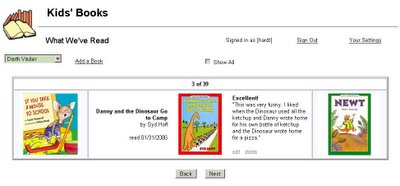
Updates to Kids' Reading List

The Cates have published the latest Carnival of Homeschooling so we can all catch up with reading homeschooling-related blogs.

Regarding our own reading, I updated the website that we use to track the kids' reading. A simple rating system lets readers rate their books from Bad to Excellent!

I also "Ajaxified" the interface so it retrieves book information on the fly instead of rebuilding the whole page. (That previous sentence may mean something to technical types.)

Anyone is welcome to track his or her reading on this site.

February 06, 2006

Streetwise and Sheltered

Our children, five and seven, are streetwise and sheltered, sophisticated and naive, in very strange ways. I wonder if these paradoxes are typical of homeschooled children.

  • They know about the war in Iraq and the controversy surrounding it, but they don't know Sponge Bob from South Park.

  • They are aware that they have biological parents and foster parents overseas, but they aren't aware that Mom and Dad have ever disagreed about matters of child-rearing.

  • They have some understanding of the major religions' creeds, but they don't recognize curse words.

  • We read them stories like The Island of the Blue Dolphins, in which wild dogs kill the heroine's brother, but we won't let them watch Jurassic Park because of the violence.

  • They are comfortable discussing President Jackson's displacement of the Cherokees on the Trail of Tears but they don't know the lyrics to any Billboard songs.
I guess Mom and Dad are sheltered too. Last week we watched Citizen Kane and Song of the Thin Man, but we haven't seen any of the films that have been nominated for this year's academy awards.

February 02, 2006

Pirate Maps and Compass Directions

One of our recent “science” lessons involved mapping and compass directions. Camille spent roughly a week on the topic and did a wonderful job working in the children's recent learning about early American history: they could understand that the Europeans came west across the Atlantic, and they now have a sense of how western expansion proceeded across the United States.

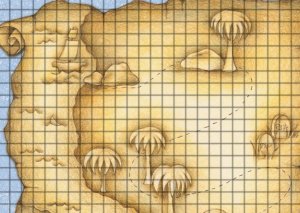
I got to cap the week with a little lesson of my own. I pulled an image of a pirate's treasure map off the Internet. It showed a desert isle with palm trees and boulders and had a weathered look about it.

Then I overlaid a grid pattern onto the map using the transparency layers built into Paint.Net (my free, image-editing tool of choice). I printed the map, drew a starting point on it, and worked out a series of steps to navigate from here to there on the paper. I put the steps into a “pirate” letter:

Dear Pirate,
A. Move two steps to the north.
B. Walk four steps to the west.
C. Swim three squares to the north.
etc.
Hugs and Kisses,
Long John Silver

Another copy of the map served as the answer key. On this copy, I drew a “treasure” on the correct end-spot. The children worked through the exercise, and when they came to the end, they punched holes in their maps. By holding their maps over my key, we could see whether or not they had successfully “found” the treasure by looking through the whole.

A few weeks later, Camille was teaching the children measurement, and I resurrected the pirate maps. This time I gave the instructions in inches: “Move two inches to the north,” etc. Again, the game was a hit.

I'm toying with the idea of creating an online version of the exercise, but I'm not sure kids would enjoy it as much. Our children really savored physically marking up their maps and punching those holes once they had pinpointed the treasures.

January 31, 2006

Reading of All Flavors

The children's booklist is working a little more smoothly than it was a week ago. Check it out to see what some of our children have been reading lately.

My own reading (Tolstoy's Resurrection) will get pushed aside today while I browse the Fifth Carnival of Homeschooling.