December 23, 2006

Carnival of Kid Comedy Is Coming

This blog will be hosting the Carnival of Kid Comedy on Tuesday, December 26. If you've posted any amusing stories about your children this holiday season, please send the following information to Carnival.KidComedy@gmail.com by midnight on Monday (Christmas!) night.

Your name:
Name of your blog:
URL of your blog:
Name of post:
URL of post:

More information about the carnival is here.

Thanks!

Christmas Pageant Politics

Jessica may play Mary in our church's Christmas pageant this year.

We're new in the very small church, and the father who is producing the pageant already had a girl in mind for Mary. The pageant will be modest, and last week we sat in the pews with other kids and parents as he assigned the parts. Eventually he said, “And that leaves Megan to play the part of Mary.”

“I want to be Mary,” called Jessica.

“We should probably have Megan be Mary,” he said. “You can be an angel. Angels get to wear the wings.”

“I want to be Mary,” said Jessica with a winning smile.

He sized up Jessica, a head shorter and visibly younger than Megan. “Well, Megan can read,” he replied.

“I can read,” piped Jessica.

“Megan's already taken some acting lessons,” he said, playing his trump. “Megan should really be Mary.”

Our trained instinct as parents is to teach our children respect and politeness: let others go first, share what you have, defer to adults.

But at some point, a deeper instinct kicks in, and we start to look out for our own. Perhaps the assumption about Jessica's lack of reading struck a nerve.

“Jessica's had acting lessons, too,” Camille said firmly.

And this is strictly true. Jessica had participated in a “Mini Movie Stars” program at a community center back in Chicago. There, some fearless young woman had attempted to herd Jessica and a dozen other four-year-olds into their roles in The Emperor's New Clothes.

As The First Thief, Jessica had chortled with sinister zeal:

Heh, heh, heh! Can't you see the cloth? Isn't it beautiful?

The villains always get the good lines.

So yes, strictly speaking, she has had acting lessons.

He backed down. “All right. Let's draw names for Mary from a hat,” he said. “Does anybody else want to be Mary?”

Now that it was a question of chance, two other girls entered the fray.

Of the four Marys in the hat, one of those last two was drawn. Victory made her shy, however, and she indicated some second thoughts. It was decided that she needed an understudy, and Jessica's name was drawn.

The shy Mary didn't make the first rehearsal, and Jessica played the walk to Bethlehem with a painful wince and a hand on her belly. (Where could she have picked that up?) We'll have to wait for Christmas Eve to find out whether she is ultimately chosen among women.

Poor Megan, alas, gets to wear the angel wings.

December 14, 2006

Robert Frost for Four-Year-Olds

When Nathaniel had just turned four, I introduced him to poetry. A great listener, he had already sat rapt through Charlie and the Chocolate Factory. I started with a handful of Shel Silverstein's lyrics for kids, then one day pulled Robert Frost from the shelf.

First I read Stopping by Woods on a Snowy Evening, maybe Frost's most accessible poem. Its bouncy, rhyming, iambic tetrameter might occur in Dr. Seuss. It is short. It paints a clear picture.

Of course it touches on dark things, and its storyline is unexciting: A man is going home with his horse when he stops and thinks. Then he continues going home.

The next night, Nathaniel surprised me by requesting more Frost. He may have been just delaying his bedtime, but he could as easily have pointed me toward the Silverstein book that still lay open. I read At Woodward's Gardens and tried to explain why a boy would taunt a caged monkey with a magnifying glass. He wanted more.

On a whim I read one of my favorites: Wild Grapes.

I should confess that I don't understand Wild Grapes. It describes a girl's moment of terror when she finds herself hanging from a high branch of a tree, unable to cling forever but afraid to let go. Her brother bends the tree and helps her down. She draws conclusions from the incident.

Wild Grapes doesn't rhyme and is longer and is quite abstract: a harder poem altogether.

But it hints at wonders: fear and revelation, the afterlife and forgiveness.

How do you read it to a boy of four? I decided just to plow through, reading aloud to myself, letting it wash over him. I hoped for a non-musical version of The Mozart Effect.

To my amazement, he scrutinized it carefully. “What's an ornament of grapes?” he interrupted. “What does that mean: 'stated in lengths of him'?” “What are banjo strings?”

He was grappling with it, but what could he possibly understand of this poem? A rush of images, perhaps. An occasional abstract noun. The rhythm of the words. His father's voice. The serenity of bedtime.

Now that he's eight, I'm afraid Nathaniel would have less patience with Wild Grapes.

Is a child who still reads picture books more content to view a disjointed stream of images? Is a toddler, still learning to speak, more attuned to, more satisfied by, the mere rhythm of words? Is a boy more open to mystery when the routine things of his everyday world—breakfast and furniture, fingers and shadows—still offer untold surprises?

He asked for another poem, but it was bedtime. “One more,” I said and turned to Frost's shortest lyric.

We dance round in a ring and suppose,
But the Secret sits in the middle, and knows.


He looked at me expectantly, so I added “The End.”

His eyes went up skeptically. “But that was no poem at all!”

Already a critic.

(This blog got a nice mention in a recent Carnival of Kid Comedy.)

December 09, 2006

I Think They Call It a "Camisole"

We continue to struggle with the gender issues.

It's getting cold, and Camille recently bought me white, sleeveless undershirts for the winter. I never used to wear them, but I'm getting to like them.

Jessica first saw me in one the other morning before work and watched, bemused, while I hastily put on a sweater.

Finally I made to leave, but she stood in front of me.

“Dad. You're not.”

“Not what?” I said, maneuvering around her to grab my travel mug full of hot chocolate. I needed to go.

“It's a joke,” she insisted. “You're joking.”

Impatiently, I said, “What's a joke, honey? I love you. Be good today.” I reached for the door.

Her amusement was turning to wonder. “You're really wearing Mom's shirt to work?”

I missed it at first—she still emits the occasional non sequitur, after all, and parents learn to filter what they hear.

“Mom!” she called the alarm. “Dad's wearing your shirt! He's dressed like a girl. Look under his sweater!”

Ah, now I understood.

I kissed the top of her head and walked out, leaving Camille to sort out the details.

December 05, 2006

Completing First Grade

Our first homeschool evaluation last May was a bit anti-climactic, actually, but I want to share the experience in case any other beginning New Hampshire homeschoolers are wondering about what they're getting into.

We located our evaluator when Homeschool Scholars in Concord hosted an information session. Camille took comfort in meeting the evaluator before signing her on. I believe the only criteria for evaluators is that they need to be certified teachers.

The evaluator scheduled a half-hour meeting at our house. It actually ran an hour.

The session didn't involve any testing of Nathaniel, just a portfolio review. Camille had assembled all of Nathaniel's “school work” from the year, including:

  • Filled-out workbook pages

  • List of books we had read to him

  • List of books he had read on his own

  • List of field trips with descriptions of what he had learned

  • Notes he had made on science experiments

  • Pictures he had drawn and sculptures he had made

The evaluator arrived with her six-year old daughter, who played outside with our kids during the meeting. Apart from shaking the evaluator's hand when she arrived, Nathaniel did not interact with her.

Camille walked her through the portfolio.

Then the evaluator explained that the formal results of the evaluation would be short and legalistic: “Nathaniel has shown age-appropriate learning advances” or something to that effect.

(The actual statement that arrived weeks later was only slightly more detailed. A few errors in grammar and spelling made us wince, but it was otherwise unremarkable.)

After the formal review was done, however, the evaluator became more personal, discussing different options in math curricula, offering advice on how to improve our planning in second grade, and complimenting Camille on a job well done.

She was especially impressed with the 24 field trips that Nathaniel took in six months. (To us, it didn't feel like many!)

Incidentally, thanks to Kim at Life in a Shoe for hosting this week's Carnival of Kid Comedy.

November 29, 2006

Dolls for Boys

Nathaniel wholly embraces gender stereotypes. He won't drink out of a pink plastic cup or use the yellow token when he plays Sorry. He loves Concentration, but not the Disney Princess edition. He still plays with trucks, but never dress-up or “house.”

Fortunately he hasn't yet learned all the intricacies of machismo. He still holds my hand in public, and he still sings in the car. . . . well, pirate songs and Christmas songs anyway. Specifically Christmas songs that don't contain any girlish words like “love.”

You can imagine my surprise last night when I heard Jessica propose that they play dolls.

“Yeah,” said Nathaniel eagerly. “Let's play dolls.”

They sat down in front of the doll house, and Jessica began narrating with authority. “I'll be the Mommy and the Daddy and the Sister, and you be the Baby. It's time for lunch. What should we make for lunch today? Let's look in the refrigerator and see . . .”

Meanwhile, Nathaniel had picked up the baby doll and stuck it head first into the doll house's toilet. He quietly waited for Jessica to notice.

“ . . . we have chocolate cake and ice cream and pasta and – Hey, Baby! You're not supposed to play in the toilet!” In pretended indignation, she plucked the baby out of the toilet and hurled him violently back into his crib.

Then she fell on her back laughing, reliving her brother's wit: “Silly Baby! You don't play in the toilet!”

By the time she sat up, she had to pluck the baby from the refrigerator. Then he was on the bookshelf . . . driving the car . . . hanging upside down from a window. Each time Jessica fell over in belly laughs until Nathaniel would start to giggle too.

I suppose that's how real men play dolls.

November 28, 2006

Roof-Repair and Child-Rearing

Our new house sports a simple roof-line with only one tricky spot where the flow of rainwater could have been misdirected. Someone dutifully installed aluminum flashing where the porch roof meets the house, guiding any water down a twelve-foot channel. Then someone else, in a rash moment perhaps, sided over the bottom of the channel, dumping all that water into the wall. The water rots the wood, of course, and the rot attracts bugs to speed its decay.

In spite of all that careful flashing, we share our new house with carpenter ants.


I was happy to fix the flaw, because I enjoy roofing. I like imagining how water runs down a slope, nudging and guiding its flow. To the astonishment of my tech-savvy colleagues, I had spent one of my rare weeks of vacation roofing our house in Chicago.

I repaired our new roof with silicone caulk and a sheet of aluminum. My flashing was adequate, but not neat. A masonry bit allowed me to pin it in place with a three-inch screw, but still it bent away from the shingles.

Could a slanting rain form ice beneath it? How do you shape those stubborn bits of aluminum once they're in place?

In my impatience my first idea seemed like inspiration.


“Help me out here,” I called to Jessica. “Please take my drill, carefully, and put it back in the box.”

I was giving her another chance. Perhaps a little traumatized by our recent move, she had been misbehaving terribly. She had broken a toy intentionally and hid the evidence. She had rolled her eyes and sighed at each of the few duties of a six-year-old, then dealt her a brother a shove on the stairs when he ignored her teasing.

Just an hour earlier, while I was precariously caulking a fan vent from the top rung, Jessica had been talking to my aunt in Chicago on the cordless phone. Out of nowhere, I heard her say, “No, please Daddy, don't make me stop talking to Aunt Agnes. I miss her!” I looked down to see her, twenty-four feet below, holding the phone at arm's length and pretending to plead with me.

“I have to go,” she lamented into the phone. “Daddy won't let me talk to you.” Then she hung up on my aunt.

What strange, six-year-old subterfuge was this? I saw red but contained myself. Within two minutes I had climbed down, called Aunt Agnes, explained and apologized, and stood by while Jessica reluctantly came clean.


I had been searching for a way to shape her behavior, and I figured that entrusting my drill to her was a peace offering of sorts: I was giving her a chance to make amends.

“Help me out here. Please take my drill, carefully, and put it back in the box.”

A little too slowly, she approached.

I removed the bit so it wouldn't break. “Put this in the box, too.”

A little too nonchalantly, she reached for my new drill.

“Use two hands,” I added sternly.

She stepped indifferently onto the porch, held the drill at arm's length, and dropped it onto its case from a height of eight inches with practiced aloofness. I choked back a reprimand and looked away.


Now for my brilliant idea. I pulled out the 12-pound head of a sledgehammer that Nathaniel had found in the woods, hauled it onto the roof, squirted some silicone under my flashing, and positioned the heavy hammer on top with duct tape. The weight held the metal flush against the shingles while the silicone dried. Tomorrow I would remove the tape. How clever I was, thinking to force it into shape this way.

Cleaning up, I couldn't locate the masonry bit. Not in the drill, not under it, not in the lid of the case, not on the nearby windowsill, not on the porch.

I eyed the cracks in the porch. They were narrow. You could push a bit through there, but you would probably have to work at it.

“Jessica!” I hollered.

Eventually she sauntered onto the porch.

I questioned her, but she looked unconcerned. I accused her of losing the bit intentionally, and still she looked at me dumbly.

Suddenly she wasn't an uncomprehending child any more. Her silence was mockery.

I gave in to my anger and ticked off every offense she had lately committed, gaining volume as I went.

She started to cry. After her stubborn refusal to bend, I was gratified to see my effect on her. I was vaguely aware that my shouting might be carrying clear to the next house on the chill autumn air, and it even crossed my mind that a good bit runs only a few dollars. But I was also mad as hell, and if it was attention she wanted . . .

Camille came out. “Are you looking for this? I thought you might lose it, so I took it inside.”

Oh, no.


My conscience repaid me with fitful sleep, even after many apologies to my daughter. Then I awoke to a loud crash. At once a series of events took shape in my mind: the cold dew had loosened the tape, the hammer had slid down the shingles, but the length of tape hung on, and instead of dropping harmlessly to the ground, the hammer had careened into the side of the house. Me and my stupid ideas. What was I thinking, using a sledgehammer for a delicate job? Well, there would be no sleeping now.

The sun rises late this time of year, so at 4:00 am it was still richly dark, except for a radiant half-moon that silhouetted the pointed pine-tops on the ground. I discovered clumps of tiny stars that I had never seen in the city, and they surprised me next to the familiar constellations.

The night echoed with the bang of my ladder against the eave. Tape and flashing shone in the moonlight. The hammer was in place. The house was intact. I still don't know what caused the crash. Maybe something fell in the cellar. Maybe something fell in my imagination. I took down the hammer and went inside for some tea.

While the pot boiled, Jessica's door squeaked open. Curious as always, she questioned me. In bare feet and flannel pajamas she seemed more sleepy toddler than schoolgirl. I urged her back to bed, caressing her cheek and rediscovering the softness there.

In the morning it rained. My new flashing, still imperfectly shaped, carried the water in spite of me. May my children do the same.

November 22, 2006

Chewbacca Was a Fuzzy Little Bear

The children recently watched Star Wars again, and it brought me back to the first time they saw the DVD. Jessica was just five at the time. She couldn't begin to follow the plot, but the music entranced her.

Some recollections:

  • Whenever another character mentioned Leia, Jessica would cry out “Where's the princess?” “There!” Nathaniel would say, exasperated, when Princess Leia was on screen. But to Jessica, whose idea of a princess involved glittering ball gowns, long gloves, and flowing hair, Princess Leia was unrecognizable. “Where?” she would persist.

  • Remember Chewbacca, the towering, ape-like sidekick who cast aside pairs of stormtroopers effortlessly with the back of his huge arm? He talked in a strange, unearthly sound that must have seemed to Jessica like a cry of pain. Twice when he grunted, Jessica asked, “They didn't hurt the little fuzzy bear, did they?”

  • Jessica also had trouble following the cuts and scene changes. After having seen Darth Vader in one scene on the rebel spaceship and in another on his own bridge, she saw him in a third location. She threw up her hands and sighed dramatically. “Another Dark Vader? There are Dark Vaders everywhere!”

November 21, 2006

Brain Quest Trivia

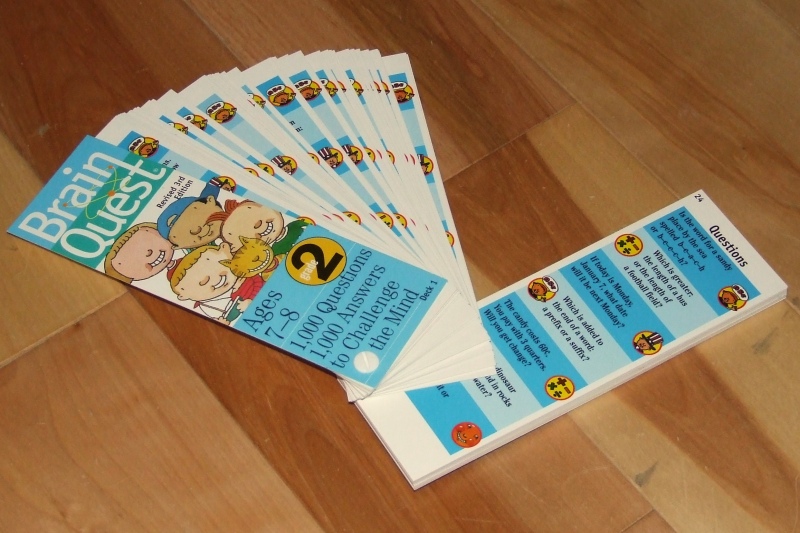
Camille's mom recently sent Brain Quest quiz cards for the kids. Believing our kids are ahead of their peers, she bought the second and third grade editions.

I didn't think I'd like these, but I do. They're just booklets of questions—sort of a Trivial Pursuit for the grammar school set. The questions vary widely in difficulty and style, so a question like “What's the math term for 6 in this problem: 6+4=10?” (the “addend”) might be followed by “What kind of number is 67: odd or even?”

Camille pulls these out for oral quizzes while the kids eat lunch, and the uneven difficulty actually serves as a motivator. They know that if they're stumped by two hard ones in a row, there's still a chance that the next question will be easy. The topics include grammar and math, light history and geography, logic, and science.

We make no effort to have the children memorize the answers. Instead the Brain Quest cards:

  1. Reinforce and give the kids a chance to show off what they already know. Nathaniel proudly recalled how to add dimes by counting by ten, for example, and Jessica beamed when she remembered that it was Abraham Lincoln who ended slavery.

  2. Serve as springboards for discussion. After Jessica correctly answered that the wind causes waves in the ocean, I reminded the children that we had heard on the news about a tidal wave caused by an underwater earthquake. Soon we were onto plate tectonics.

August 19, 2006

Tomboy Princess

I have only brothers, so girls were, and probably still are, a mystery to me, but I always preferred the tomboys. I admired their pluck and their deft, athletic manner of carrying themselves. They spoke confidently and behaved alike in the company of other girls, boys, or even adults.

Early in my adolescence I lost interest in the the more feminine girls. I never knew what to make of them, made-up and giggling, whispering to one another behind turned backs. When I finally dated some tomboys, they put me in my place often enough for me to appreciate their verbal directness.

My wife, Camille, is a knockout, but a plain-spoken, tomboy knockout. Her unequivocal dealing ranks high on her list of attractions.

Now my daughter, like many six-year olds of unroyal lineage, wants to be a princess. A couple of her aunts share this ambition, but I'm resisting it.

And I'm losing.


Jessica's femininity will not be subdued.

Our landlady outfits her hair with exotic braids. High heels, boas, and rhinestone tiaras keep making forays into the toy box. I once worked for Mattel and learned firsthand not to tolerate Barbie, but the Disney Princesses (TM) have effected a deep incursion into our home.

Jessica's clothes, mostly presents from female relations, tend toward the pink and are equipped with flower patterns and lace. (Camille succeeded in repelling both halters and hip-huggers before they secured a beachhead.)

When a stranger once called her "cute," Jessica smiled benevolently, flipped her hair, and tried to sashay off like a runway model—until Camille spun her around and prompted her to say "Thank you."


Her daintiness does not extend into the kitchen. She loves her food and burns it fast. I remember how proud she used to be when her one-year old belly would balloon after a meal, protruding over her diaper. I miss that belly. I once overheard a mom tell her cookie-eating toddler to “watch your figure.” We don't believe that six-year old Jessica has a figure, let alone that she should watch it.

We try to encourage sports, but fail—probably because we're not sports fans or athletes ourselves. Jessica enjoys running races, but not football or baseball.

Jessica's first inclination when she skins her knee at the playground is to scream for attention. Her dignity more injured than her leg, she demands to be coddled, then works herself into a pique. At the risk of being callous, I've learned to make light of these scrapes and bruises. Usually a hug and a “Can you bend it?” are enough to restore her composure and set her on her way.

We try to encourage her interest in making things: Legos and crafts and such, but Jessica's engineering aptitude doesn't currently extend beyond coloring.

Her big brother inadvertently does more to steer her towards being a tomboy than I do. Outside, she aims to keep up with him physically. Inside, she'll find herself playing dinosaurs or knights more often than “Dress Up” because older Nathaniel steers their play.

That's another struggle. We try to encourage her to stand up for herself—not to let Nathaniel dictate what she does all the time, not to stand by helplessly while some bully on the playground mistreats her or another child.

Our results are mixed. At times Jessica makes us proud, at times she plays the victim, and at times she even becomes the bully. She has been guilty of decidedly un-princess-like shoving.


Pretend boyfriends pose the worst challenge to my tomboy designs. Any older boy whom Jessica meets is a potential sweetheart. I can't recall when the word “boyfriend” invaded her vocabulary, but it was a dark day. For months we were likely to overhear this sort of monologue from the next room:

Oh, Luke. You can't be my boyfriend anymore because now Scott is my boyfriend. [A pause.] Okay, you don't have to cry. Scott is very handsome, but you can be my boyfriend, too.

We tried ignoring this behavior, disallowing it, framing it as babyish in order to make it unappealing, and even asking her blankly why she wanted a boyfriend (or two).

At last boyfriend-play seems to be on the decline . . . but has she abandoned her imaginary beaus or just learned to make-believe more quietly?


I used to worry about those feminizing aunts. I recall the party when they shuffled baby Jessica into a back room and she emerged vaunting lipstick and rouge. I remember how they lobbied to have her ears pierced. Visits from the aunts always left a trail of clinquant costume jewelry behind.

Now I'm starting to worry about peers. Her aunts, confident adults themselves, want what's best for Jessica and respect us, her parents. I'm afraid her peers won't be so benign. At six, Jessica and her friends don't scrutinize each other's appearances, judge each other's fashions, or compare real boyfriends. At sixteen, I suppose they will.

Ultimately I know I can't make my daughter a tomboy--but can't I at least nudge her in that direction?

I had one early victory, and the memory of it gives me hope. Jessica was about three, a huge Christmas party was in full swing, and both children were trying hard to consume a month's worth of desserts amidst the chaos. When Camille realized how much they had eaten, she insisted the kids have no more sweets. Pretending not to have heard, a guest sneaked Jessica another chocolate. I saw.

“Did Mommy say 'No more desserts'?” I interrupted.

Jessica nodded, putting the chocolate back onto the tray.

“Oh, all right,” said the guest. Then she turned to Jessica. “You want to keep that nice figure anyway.”

Jessica, only vaguely sure of what was being said, lifted her shirt and threw back her shoulders, beaming.

“I have a BIG belly!” she exclaimed.

You won't hear that from a Disney princess.