August 19, 2006

Tomboy Princess

I have only brothers, so girls were, and probably still are, a mystery to me, but I always preferred the tomboys. I admired their pluck and their deft, athletic manner of carrying themselves. They spoke confidently and behaved alike in the company of other girls, boys, or even adults.

Early in my adolescence I lost interest in the the more feminine girls. I never knew what to make of them, made-up and giggling, whispering to one another behind turned backs. When I finally dated some tomboys, they put me in my place often enough for me to appreciate their verbal directness.
My wife, Camille, is a knockout, but a plain-spoken, tomboy knockout. Her unequivocal dealing ranks high on her list of attractions.

Now my daughter, like many six-year olds of unroyal lineage, wants to be a princess. A couple of her aunts share this ambition, but I'm resisting it.

And I'm losing.


Jessica's femininity will not be subdued.

Our landlady outfits her hair with exotic braids. High heels, boas, and rhinestone tiaras keep making forays into the toy box. I once worked for Mattel and learned firsthand not to tolerate Barbie, but the Disney Princesses (TM) have effected a deep incursion into our home.

Jessica's clothes, mostly presents from female relations, tend toward the pink and are equipped with flower patterns and lace. (Camille succeeded in repelling both halters and hip-huggers before they secured a beachhead.)

When a stranger once called her "cute," Jessica smiled benevolently, flipped her hair, and tried to sashay off like a runway model—until Camille spun her around and prompted her to say "Thank you."


Her daintiness does not extend into the kitchen. She loves her food and burns it fast. I remember how proud she used to be when her one-year old belly would balloon after a meal, protruding over her diaper. I miss that belly. I once overheard a mom tell her cookie-eating toddler to “watch your figure.” We don't believe that six-year old Jessica has a figure, let alone that she should watch it.

We try to encourage sports, but fail—probably because we're not sports fans or athletes ourselves. Jessica enjoys running races, but not football or baseball.

Jessica's first inclination when she skins her knee at the playground is to scream for attention. Her dignity more injured than her leg, she demands to be coddled, then works herself into a pique. At the risk of being callous, I've learned to make light of these scrapes and bruises. Usually a hug and a “Can you bend it?” are enough to restore her composure and set her on her way.

We try to encourage her interest in making things: Legos and crafts and such, but Jessica's engineering aptitude doesn't currently extend beyond coloring.

Her big brother inadvertently does more to steer her towards being a tomboy than I do. Outside, she aims to keep up with him physically. Inside, she'll find herself playing dinosaurs or knights more often than “Dress Up” because older Nathaniel steers their play.

That's another struggle. We try to encourage her to stand up for herself—not to let Nathaniel dictate what she does all the time, not to stand by helplessly while some bully on the playground mistreats her or another child.

Our results are mixed. At times Jessica makes us proud, at times she plays the victim, and at times she even becomes the bully. She has been guilty of decidedly un-princess-like shoving.


Pretend boyfriends pose the worst challenge to my tomboy designs. Any older boy whom Jessica meets is a potential sweetheart. I can't recall when the word “boyfriend” invaded her vocabulary, but it was a dark day. For months we were likely to overhear this sort of monologue from the next room:

Oh, Luke. You can't be my boyfriend anymore because now Scott is my boyfriend. [A pause.] Okay, you don't have to cry. Scott is very handsome, but you can be my boyfriend, too.

We tried ignoring this behavior, disallowing it, framing it as babyish in order to make it unappealing, and even asking her blankly why she wanted a boyfriend (or two).

At last boyfriend-play seems to be on the decline . . . but has she abandoned her imaginary beaus or just learned to make-believe more quietly?


I used to worry about those feminizing aunts. I recall the party when they shuffled baby Jessica into a back room and she emerged vaunting lipstick and rouge. I remember how they lobbied to have her ears pierced. Visits from the aunts always left a trail of clinquant costume jewelry behind.

Now I'm starting to worry about peers. Her aunts, confident adults themselves, want what's best for Jessica and respect us, her parents. I'm afraid her peers won't be so benign. At six, Jessica and her friends don't scrutinize each other's appearances, judge each other's fashions, or compare real boyfriends. At sixteen, I suppose they will.

Ultimately I know I can't make my daughter a tomboy--but can't I at least nudge her in that direction?

I had one early victory, and the memory of it gives me hope. Jessica was about three, a huge Christmas party was in full swing, and both children were trying hard to consume a month's worth of desserts amidst the chaos. When Camille realized how much they had eaten, she insisted the kids have no more sweets. Pretending not to have heard, a guest sneaked Jessica another chocolate. I saw.

“Did Mommy say 'No more desserts'?” I interrupted.

Jessica nodded, putting the chocolate back onto the tray.

“Oh, all right,” said the guest. Then she turned to Jessica. “You want to keep that nice figure anyway.”

Jessica, only vaguely sure of what was being said, lifted her shirt and threw back her shoulders, beaming.

“I have a BIG belly!” she exclaimed.

You won't hear that from a Disney princess.

June 21, 2006

Oedipus and Electra

While we were walking into town for ice cream the other day, Nathaniel asked his mother to hold his hand. Camille did. He said, “No, like Daddy holds it,” and carefully put her arm through his.

Then he added “Now we're married.”

These moments are precious. At six and seven, the kids seem so often to push us away, to assert their independence, to establish their distance, that we really cherish the moments when they want to be close.

Pretending to be married to Mom is a paradox of independence.

On the one hand, Nathaniel is envisioning his adulthood. He's recognizing that someday he will be a man, possibly a husband. On the other hand, he's craving intimacy with his mother, a little jealous of her bond with Dad.

Jessica has recently learned how to wink. She hasn't mastered the subtleties yet. Her winks involve turning her head sideways and painstakingly scrunching the right side of her face while she stretches her eye open on the left, maintaining a furrow of concentration on her forehead all the while. But she's proud of the skill, and in her weaker moments even teases her big brother. “When are you going to learn to wink, Nathaniel? It's not hard. All you have to do is this. See? Mom, I wonder why Nathaniel can't wink. . . .”

At the table last week, Jessica winked at me. I winked back.

“Don't you wink at my husband,” Camille teased.

“Why not?”

“Because girls shouldn't wink at married men.”

Forbidden fruit is succulent, indeed. At every meal since, whenever there's been a moment of quiet, Jessica has remembered to wink at me.

“Look, Mom,” she says impishly, through a carefully contorted face. “Look! I'm winking at a married husband.”

(When I want to read about other children's antics, I check out the 25th Carnival of Homeschooling.)

June 17, 2006

Learn Geography by Taking Over the World

I learned my world geography from Risk. Military conquest over his father motivates a boy to learn a map, and I can picture the Risk game board to this day.

This learning strategy has a couple of problems, however.

One is that Risk's “countries” are archaic and imprecisely defined. The game's Siam is our Thailand. The game treats Yakutsk, Irkutsk, and Siberia like three countries, but—if I understand rightly—Yakutsk and Irkutsk are actually a city and a territory within Siberia, which is a region within Russia.

Another problem is that Risk merges countries into convenient regions. On that embarrassing day in high school when I was unable to locate France on a world map, I really did know the location of Western Europe, a Risk "country."

Nathaniel's at the age where he would love Risk, and I wish the game were available with a map closer to the real world. Laying out all the countries of the Middle East as potential sites of conquest in an American board game might smack of imperialism, but it would be the most educational sort of imperialism.

Anyway, I don't believe all those hours of Risk ever infected me with a subconscious desire to colonize Irkutsk.

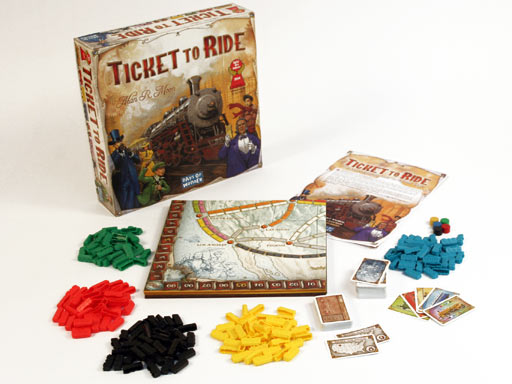
Recently I had a chance to try an even better game, Ticket to Ride, at Geeks and Gamers. It's devilishly easy to pick up, but the longer I played, the more new strategies I discovered. I can't recommend it highly enough.

The object is to build railroads linking cities across North America. The board is a map of the United States and a bit of Canada, with several city names on it.

Nathaniel would love it, but I wish it worked with all 50 states instead of a handful of cities.

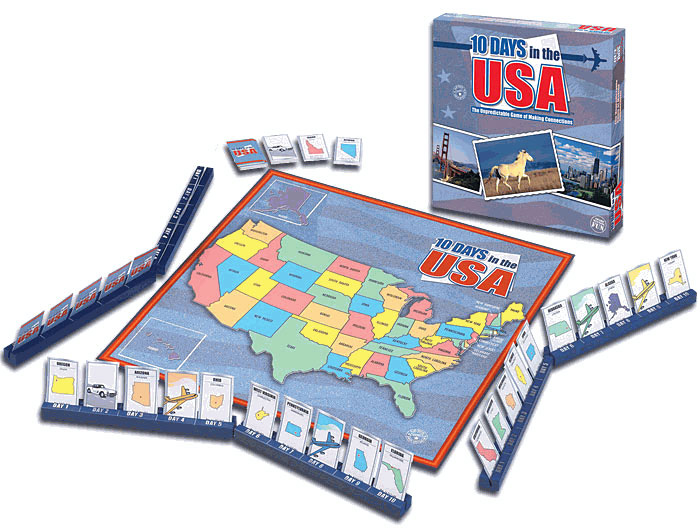
Instead I bought 10 Days in the USA.

It didn't hook me at once like Ticket to Ride, but it's growing on me. It features a clearly labeled, brightly colored map of the United States. The object is to acquire 10 state cards that represent a 10-day "journey." That means adjacent cards have to be adjacent states. Some car and airplane cards are also included to let you work with states that aren't adjacent.

Playing the game with Camille has had a funny psychological effect on me. Now I feel a new affinity for states like Tennessee and Missouri, which border eight states each, but I'm uneasy about Maine—a state I used to like—which borders only New Hampshire.

10 Days in the USA seemed like an ideal teaching tool. Like Risk and Ticket to Ride, it teaches not only the names of places, but also their locations.

Unfortunately it's too hard for our kids. The box recommends it for children over ten. For children who are still struggling to locate the states and read their names, the rules and strategies are just too abstract.

The game board and the cards do provide a great tool set for creating our own educational games, however. What homeschooler wouldn't want a clear map of the United States with a corresponding set of color-coded state cards?

This morning the kids and I tried it with my own set of rules. Jessica won. They liked it. These are the rules we used.


10 Days in the USA—Little Kids' Rules

Objective
To acquire five state cards depicting adjacent states.

Setup
The Alaska and Hawaii cards are removed from the deck: these are not used. All the other cards are shuffled and left face down in a pile.

Play
Players take turns, beginning with the youngest.

A player begins his turn by picking 1 card and turning it face up in a common pile.

If the card is a car, the player discards it and picks 2 more cards instead.

If the player chooses, he can return any number of cards from his hand to the common, face-up pile.

If the player sees 2 or more face-up cards depicting adjacent states, he can choose to take those cards into his hand.

Play proceeds to the next player.

Rules
Airplanes are wild cards. An airplane can represent any state that is the same color as the airplane. For example, a yellow airplane could be used in place of Illinois or Utah.

The cards in the player's hand must always be contiguous so that you could draw a line through them without passing through any other states. For example, a player could have Illinois, Missouri, and Arkansas in his hand, but could never have Illinois, Missouri, and California in his hand.

The first player to acquire five adjacent cards (including any airplane wild cards) wins.

June 02, 2006

Amusing Moments in Fatherhood

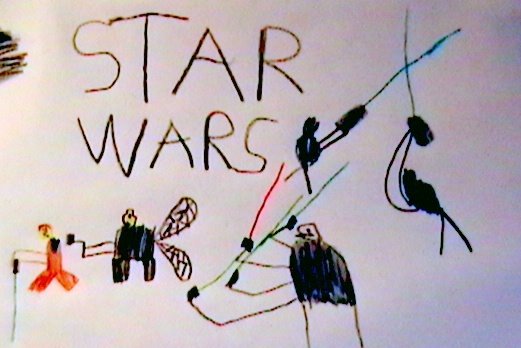
Chalk scribbles covered the driveway. Within this asphalt spaghetti I recognized many instances of Jessica's name, several flowers, and that four-armed robot guy from the recent Star Wars movies. Closer to the house were a skull and crossbones with a curse: "Do not inter or you will be destroyd." It was signed "KKK" in giant, careful letters. I made a mental note to investigate, but inside I discovered mud tracked all over the floor and immediately forgot.

  •  

At bedtime, Jessica and I were reading to each other, side by side on our backs. I read my pages (on the left) and she read hers (on the right). The tale was yet another Junie B. Jones adventure. Since she's read each book in this series five or six times by now, I occasionally tease her by changing the words. I ad-libbed a T-Rex into a scene in Junie B's kindergarten.

Jessica didn't pretend to complain like she usually does. Instead she quietly closed the book, set it on her nightstand and pointed at the door. "If you're not big enough to read with me," she asserted quietly, "you have to go."

I apologized, but she stuck to her guns. I had lost my bedtime story.

  •  

In one volume, Junie B. is upset because she received one valentine fewer than her classmates did. She's trying to figure out who stiffed her. Then her teacher approaches.

"Junie B.? I have some good news for you!" she said. "Guess what I just found in the bottom of the valentines box?"

I sat up real quick.

'Cause guessing games are my favorites, of course.

"A meatball," I said.

We lived that moment recently. Camille was reading something to the kids at the dinner table and the word occupation came up.

"What's occupation?" asked Jessica.

"An occupation's a job," said Camille. "Daddy's occupation is software engineer. What's grandpa's occupation?"

Grandpa's been a high school teacher for—let's see—over 65 years now. Jessica knows this. He talks about school all the time. She's been to his school.

"Dentist," she said, immediately and confidently, although the only dentist she's ever met is her own, a young woman.

  •  

The entire roll of toilet paper had been carelessly unrolled, then very carefully rerolled in an attempted cover-up. At once I suspected Nathaniel, who holds zealously that rolls of toilet paper, like Q-Tips, exist primarily for play and secondarily for hygiene.

I met him in the hall. He had cardboard wings affixed to his arms and long pieces of masking tape attached to his hair.

"You're frozen!" he said.

"What did you do the toilet paper?" I seethed.

"I'm a gorgon. You're frozen!" he said.

"You better tell me what you did to that toilet paper right now, or . . . "

"I didn't do anything. Talk to Jessica." With a flap of his wings, he was off.

After locating Jessica, I repeated my inane question.

She burst into tears: "By accident I played with it?"

  •  

The kids were chalking up the driveway again. Nathaniel was dutifully inscribing another threat in front of the door: "Beware! Go bak or meet thy doom!"

"This is a pirate warning," he said proudly. Then he added "KKK" with a flourish.

"What are the Ks for?" I asked.

"They're your DOOM!"

I threw up my hands helplessly and waited.

"It means cutting your throat." Impatiently he drew his finger across his throat and made a guttural sound: "Kkkkk . . . ."

May 28, 2006

Food Poisoning

Camille's mother came into town for a four-day visit this week. That would normally be great news, but this time the visit went sour. Camille, her mother, and I contracted food poisoning after ordering from Kalliope. Camille's mom was briefly hospitalized: food poisoning can be particularly tough at 88.

We're all recovering slowly: two days later I've had four Saltines and am drinking a cup of tea. We're just sorry that Mom's trip was spoiled by the incident.

This story has a silver lining, however. While Camille and I were at the height of our sickness, sometimes retching simultaneously into our two toilets, the kids (who had eaten pizza) did an amazing job taking care of us. They were attentive and brought us glasses of water or the telephone or books. They were respectful and stayed away while we napped. They prayed for our recovery. Jessica even tried to do all the kitchen dishes herself and read a story to Camille.

Most amazing, they did not fight. I can't remember another day when they played so peaceably. They never raised their voices all day.

They were a bit scared at seeing both of us sick, and I think they were even scared by the weird sort of carnival day they had. They enjoyed unlimited access to TV and video games—a first for our household. Their diet tended towards M&Ms, fruit snacks, and other sugary treats.

Still, it was wonderful to know that they can pitch in when they need to.

May 01, 2006

Pangea and the Colonies


This is the risk of homeschooling your kids, in a microcosm:

This afternoon Nathaniel and I were hiking up Bear Mountain. We had been singing It's Christmas at Ground Zero in the car (one of my favorites), and he was still humming it. He was leading (as always), and he missed a turn in the trail.

I set him straight, but he blamed the painted marker on the tree. Whoever paints the trails had missed this tree for at least a season, so there were just a few faded bits of paint on the bark where there should have been a neat yellow rectangle.

"Look at this paint!" he said shaking his head. "They should redo this. It's all broken apart. It's pangea!" He started chortling. "It's like the United States went backwards and became thirteen colonies again."

Then he laughed so hard at his own joke I had to stop until he collected himself.

April 19, 2006

Hair Conditioner vs. Lucy and Ricky

At five, Jessica is finally developing a sense of modesty. I think the days of my helping her out when she showers are at an end.

This is good news. As an infant, Jessica went into hysterics whenever she felt water on her face. Just as she outgrew that phobia, her hair became long enough to tangle.

Tangles in Jessica's hair were such a large part of our family life that Camille actually began naming them—the tangles—after characters from I Love Lucy. To this day, if Jessica feels a pull over her left parietal lobe, she'll say menacingly, "Watch it, Ethel!"

I've always been short-haired, so I had no experience with snarls. After years of struggling quietly, I finally appealed to Camille for guidance and learned how to remove tangles from Jessica's hair. Since I'll probably forget soon, I record this for posterity.

  1. Let the child wet her own hair. She will take too long and concoct Gordian knots on her head.

  2. Help the child shampoo.

  3. Let the child rinse. Generally I pull out a book and let her play a bit at this point.

  4. Apply conditioner. I used to think of conditioner as some alchemical potion that gives hair "body" and "luster." Camille taught me it's a simple lubricant, like WD-40 or vegetable oil. Conditioned tangles slide apart easily. Camille suggested that I needed to condition only the hair hanging down Jessica's back, but I take no chances and coat her whole head.

  5. The child can bathe while the conditioner soaks in.

  6. Starting at the bottom, brush her hair downward. This means that for the first few strokes of the brush, I fix only the tangles at the bottom of the hair. Once they are cleared out, move up an inch, and repeat. If the child's hair is long enough, you can also grip the middle of it tightly in one hand so that even if tangles exist at the end, the child will not feel the pulling.

  7. Be careful not to brush too hard against the child's scalp. (I wrongly assumed for months that Jessica was complaining about hair pulls from tangles, when actually I was scraping her scalp with the bristles.)

  8. Brush her hair under the shower stream until the conditioner is mostly rinsed out.

In short, my answer is chemical warfare: in the battle against tangles, conditioner is my weapon.

April 11, 2006

Funny Moment at Church

Another homeschooling father recently described his daughter's reminding a priest of the role of Mary in salvation history.

His story brought to mind something Jessica said once.

We encourage our kids to pay attention to the Gospel readings, and (most of the time) Camille even prepares them in advance.

Once we were attending Mass in the chancel of a Benedictine monastery--very close quarters. The reading was Matthew's Infancy Narrative.

Jessica sat quietly until Herod's line, "Go and search diligently for the child, and when you have found him bring me word, that I too may come and worship him." At that point she couldn't contain her excitement and hissed audibly, "He's lying. He wants to kill Jesus!"

The reader only paused a moment to compose himself, but there was laughter in everyone's eyes.

April 10, 2006

Make Your Own Educational Map

[This post is out-of-date. The growth in online maps in the past couple of years has been staggering. If you are interested in customizing maps for educational use, I recommend the My Maps feature in Google Maps. And make your maps public, so the rest of us can use them, too!]

I've recently created a website that I want to share with other homeschoolers. It's here (www.kids.criticalmap.com).

When I first saw Google's online maps over a year ago, I thought they would be useful in education. I pictured some kind of website where parent-teachers and students could mark up an electronic map with whatever they were studying.

The map would be on a website, so students could see it and manipulate it from anywhere. The map would store their notes and let other people view them. Students could change it at any time. Also they could send to friends or to Grandma an email that linked to their map.

Since the maps are zoomable, they could do anything from labeling the countries that provided components for the International Space Station, to tracking troop placements at Barrett's Farm and South Bridge during the Battle of Concord.

Now the site is up. It's free and anonymous. (I don't like posting children's names on the Internet.)

So create some maps with your children, and let me know what you think.

Feel free to invite anyone else to try it out as well. (I even have a couple of public school teachers interested. . . . )

April 06, 2006

Anthropomorphic Melodrama

Jessica, almost six, is currently struggling with "greater than," "less than," and "equals."

A number line runs the length of our kitchen ceiling. Block towers of different heights form a miniature metropolis on our table. Trains with different numbers of cars provide mass-transit. We divide and count our peas at supper. We haven't actually built a balance scale yet, but I'm planning one!

It's possible that Jessica's just not ready for this: that some uncrossed threshold of cognitive development precludes her comparing quantities in her head.

But do we give up?

This morning when Camille and Jessica started comparing quantities, Jessica, again, glazed over, became distracted, and answered at random, scrutinizing Camille's face for hints without actually thinking about the problems.

Then, out of the blue and on her own, Jessica forged a new path towards understanding: "Are the big numbers proud of how big they are?"

Camille calls this the "anthropomorphic melodrama" approach to pedagogy. Numbers have feelings, just like people, so any math problem has the potential to become a soap opera. We try not to turn all of Jessica's lessons into emotional allegories, really. But this time, desperate for a new approach, Camille ran with it.

"Yes, the big numbers are very proud that they're so big. They're the ones over here."

"And the little numbers are sad? Because they want to be big, too?" Jessica pointed to the left end of the number line.

"That's right, the little ones are sad."

Shamelessly, I pitched in. "Sometimes the big ones can be mean, and they tease the little ones."

"We're big [pointing to the right], and you're not [pointing to the left]," Jessica said, tormenting the little numbers in her pretend voice.

"Oh, no," Camille said. "The little ones are starting to cry."

Were we teaching math? Teaching gender stereotypes? (Nathaniel's numbers don't cry, after all). Both?

I don't know. . . . but she was starting to get it!